Best Stocks to Buy in Indian Stock Market for Long Term 2026
- Safdar meyka
- Apr 14
- 3 min read

The Indian stock market in 2026 continues to attract global attention with steady economic expansion and strong corporate earnings. The Indian stock market remains one of the fastest-growing equity ecosystems, driven by technology, banking, and infrastructure sectors. As of 2026, benchmark indices like Nifty 50 and Sensex represent India’s core listed companies, reflecting broad economic health and investor confidence.
The Indian stock market operates primarily through the National Stock Exchange (NSE), established in 1992, and the Bombay Stock Exchange (BSE), founded in 1875. Together, they host thousands of listed companies across multiple sectors. Investors continue to focus on long-term wealth creation strategies, typically ranging from 5 to 10 years, supported by India’s rising GDP and digital transformation.
In this article, we explore the Indian stock market from a long-term investment perspective. We highlight strong companies, sector trends, and key data points that shape investment decisions in 2026.
Indian Stock Market Structure and Long-Term Growth Outlook
Market Framework and Key Indices
The Indian stock market is structured around two major exchanges: NSE and BSE. The Nifty 50 index includes 50 large-cap companies, while the Sensex tracks 30 major firms. These indices act as benchmarks for overall market performance and investor sentiment.
The Indian stock market has shown consistent long-term growth, supported by rising retail participation and institutional inflows. According to NSE India, equity market participation has expanded significantly in recent years, reflecting stronger financial literacy and digital trading access. The SEBI Act of 1992 ensures regulatory stability and investor protection.
Key structural facts include:
NSE founded in 1992
BSE founded in 1875
Nifty 50 includes 50 companies
Sensex includes 30 companies
This structure ensures liquidity, transparency, and long-term stability in the Indian stock market.
Best Stocks in Indian Stock Market for Long Term 2026
Blue-Chip Leaders Driving Growth
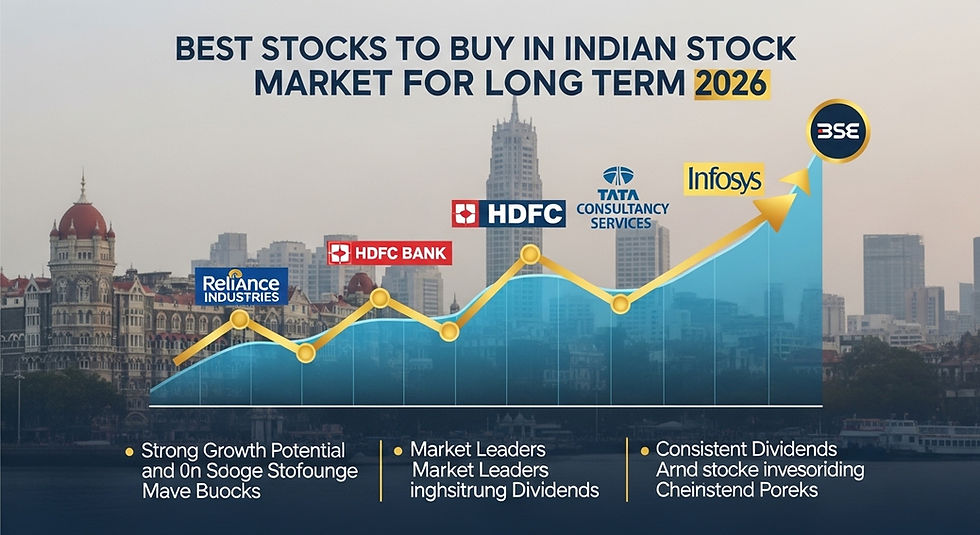
The Indian stock market long-term story is dominated by strong blue-chip companies with stable earnings and global presence. These firms consistently reinvest profits, reduce debt, and expand across sectors. Investors prefer them for stability and compounding growth over time.
Key long-term stocks include:
Reliance Industries
Tata Consultancy Services (TCS)
HDFC Bank
Infosys
ICICI Bank
Larsen & Toubro
These companies represent banking, IT, energy, and infrastructure. The Indian stock market rewards such diversified exposure, especially during economic cycles. Strong balance sheets and consistent dividend policies make them attractive for 2026 and beyond.
Takeaway: Long-term wealth in the Indian stock market is driven by consistent earnings and sector leadership.
Sector Analysis in Indian Stock Market 2026
Banking, IT, and Infrastructure Momentum
The Indian stock market in 2026 is strongly supported by banking, IT, and infrastructure sectors. Banking benefits from credit expansion, while IT firms gain from global digital transformation. Infrastructure growth aligns with government capital expenditure programs.
Key sector highlights:
Banking credit growth remains above 10% annually
IT exports continue to expand with AI integration
Infrastructure spending supports long-term GDP growth
These trends show structural strength in the Indian stock market, not just short-term momentum. Investors focusing on these sectors often achieve stable compounding returns over long periods.
Takeaway: Sector diversification remains essential in navigating the Indian stock market.
Top Long-Term Stocks Table (2026 Overview)
Core Companies and Sector Strength
Below is a simplified long-term view of key companies in the Indian stock market:
Company Name | Sector | Market Role (Long Term) |
Reliance Industries | Energy/Digital | Diversified growth leader |
TCS | IT Services | Global software exporter |
HDFC Bank | Banking | Private banking leader |
Infosys | IT Services | Digital transformation leader |
ICICI Bank | Banking | Retail & corporate banking |
Larsen & Toubro | Infrastructure | Engineering & construction |
This table highlights how the Indian stock market is shaped by diversified sector leaders. Each company contributes to stability and long-term capital growth. Investors often combine these stocks for balanced portfolios.
Takeaway: Diversified exposure improves resilience in the Indian stock market.
Risks and Long-Term Investment Strategy in Indian Stock Market
Volatility, Inflation, and Global Influence
The Indian stock market is not risk-free, as global events, inflation, and interest rate changes impact valuations. Short-term volatility is common, especially during geopolitical or economic shifts. However, long-term investors often benefit from recovery cycles.
Key risk factors:
Global crude oil price fluctuations
Foreign institutional investor outflows
Domestic inflation pressures
Currency exchange volatility
Despite these risks, the Indian stock market has historically recovered strongly over long cycles. Long-term strategies such as SIPs (Systematic Investment Plans) help reduce timing risks and smooth returns.
Takeaway: Discipline and patience are essential for success in the Indian stock market.
Conclusion
The Indian stock market continues to show strong structural growth supported by stable policy frameworks and expanding corporate earnings. Long-term investors benefit from diversified exposure across banking, IT, and infrastructure sectors. The Indian stock market rewards consistency, patience, and data-driven decision-making over short-term speculation.
With strong companies and rising participation, the Indian stock market remains a key destination for wealth creation in 2026. Investors focusing on fundamentals are better positioned for sustainable returns over the next decade.


Comments